Can Some Organisms Survive Without Energy From the Sun
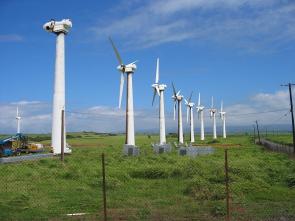
In ordinary language, people speak of "producing" or "using" energy. However, we when we say "produce energy" nosotros actually mean to convert energy from one course into another. For example, the stored energy of water behind a dam is released when the water flows downhill and drives a turbine generator (Fig. 1A). Similarly, windmills allow the states to capture energy when the current of air is bravado (Fig. 1B).

Energy in Your Food

All of the energy we get from food can exist traced back to the sun! Plants employ energy from the sun to catechumen water and carbon dioxide into usable sugars, a process chosen photosynthesis. Those plants may and then be eaten by bugs, who are eaten by animals, who are so eaten by larger animals. So, the whole process is powered by the sunday!
The food we eat fuels our body to grow, heal, stay warm, and gives us energy throughout the day. In our everyday lives, we might consume a chicken that ate a caterpillar that ate a leafage that grew through photosynthesis. The labels on our nutrient provide an ingredient list and nutrition facts to help us know what we are eating (Fig. ii).
Food Bondage
Food bondage are simplistic models that describe the feeding relationships among various species of organisms in an ecological customs. Food chains are useful tools for understanding the trophic levels of organisms in an ecological customs. Arrows are used to correspond the transfer of energy from each level in a linear style (Fig. 3).

In this food chain example, the algae stand for the primary producers, which are autotrophic organisms that brand their own food by converting the energy from sunlight into food free energy. Consumers are heterotrophic organisms that cannot produce their own food and must obtain food by eating other things. The body of water urchin is a herbivore, an eater of plants or algae, and is a principal consumer in this example. Carnivores eat herbivores and other types of carnivores. The octopus is a carnivore, and considering information technology is the first carnivore in the food chain, it is also a primary carnivore. The eel is a secondary carnivore. And finally, the ulua is the top predator in this food chain case because no other consumer eats it.
Nutrient Webs
In a given ecosystem or community, many different nutrient chains can be combined into a food web (Fig. 4). Food webs give a more realistic film of feeding relationships.
Consider, for example, the food chain described in a higher place. In reality, the algae is eaten by ocean urchins as well every bit past a variety of different species of fish and other invertebrates. In a nutrient web diagram, many arrows can be used to point from the algae to multiple different organisms that feed on information technology. Likewise, other types of consumers eat bounding main urchins and octopus and eels. Many arrows can be fatigued to business relationship for the feeding relationships of the diverse organisms in the coral reef community.

This Fish Life handout was produced by the Segmentation of Aquatic Resources and funded past the Federal Aid in Sport Fish Restoration Program. Others like this are indexed and dowloadable on this NOAA site.
The Transfer of Free energy
Plants capture energy directly from the dominicus. All nutrient sources can be traced back to plants. Every bit the primary producers, plants sit down at the base of the energy pyramid (Fig. 5). The different parts of the pyramid are chosen trophic levels. Just a fraction of free energy really gets transferred from 1 trophic level to the next. Virtually oftentimes, some energy is used to do work and some energy is lost as heat to the surrounding environment. The aforementioned idea can be practical to the energy our bodies need to survive. Each successively higher trophic level has less and less energy bachelor. In a bulk of communities, the drop in energy bachelor at each trophic levels is reflected every bit a driblet in the relative abundance (number of organisms) and total biomass (amount of living matter per unit area) of organisms. This is depicted by the smaller and smaller trophic levels within the pyramid.

Conservation of Energy
Free energy is conserved over time. Although some free energy is lost every bit heat when animals assimilate their food, heat is also a form of energy. And, heat is an important type of energy for keeping mammals, like humans, warm. But, even when energy is lost every bit heat to the surroundings, the energy itself is not destroyed.
For example, when wood burns, most of the energy in the wood matter is converted into heat. Some of that heat volition escape, and some may be captured to do work, like cooking or warming a business firm. And, some of the energy and affair from the forest will be left over in the grade of ash (which can be added to soil and the remaining energy used past some organisms).
Energy from the Dominicus Vocabulary
- Autotrophic: any organism capable of self-nourishment by using inorganic materials as a source of nutrients and using photosynthesis or chemosynthesis every bit a source of energy, as most plants and certain bacteria.
- Carbon dioxide (CO2): a colorless, odorless gas made of one carbon atom and two oxygen atoms bonded together. CO2 is produced by plants and animals during cellular respiration. CO2 is as well producedby burning carbon and organic compounds. CO2 is naturally present in air and is absorbed by plants during photosynthesis.
- Carnivore: animals that feed primarily or exclusively on animal affair.
- Consumers: an organism requiring circuitous organic compounds for nutrient which it obtains by preying on other organisms or by eating particles of organic thing
- Energy Pyramid: a graphical model of free energy flow in a community.
- Nutrient Concatenation: simplistic linear models that draw the feeding relationships among various species of organisms in an ecological community.
- Nutrient Web: The combination of many different food chains in a given ecosystem or community that requite a more realistic moving-picture show of the feeding relationships.
- Herbivore: animals that eat simply plants
- Heterotrophic: organisms that obtain nourishment from the ingestion and breakdown of organic matter, such every bit plants and animals
- Photosynthesis: the procedure by which green plants and some other organisms employ sunlight to synthesize foods from carbon dioxide and water. Photosynthesis in plants generally involves the green pigment chlorophyll and generates oxygen as a byproduct.
- Predator: an organism that primarily obtains food by the killing and consuming of other organisms
- Primary Consumer: an animal that feeds on primary producers; herbivore.
- Primary Producers: whatever green plant or any of various microorganisms that tin can convert light energy or chemical energy into organic matter.
- Secondary Consumer: an fauna that feeds only upon herbivores; carnivore.
- Trophic Levels: any class of organisms that occupy the same position in a food concatenation, as primary consumers, secondary consumers, and 3rd consumers.
Source: https://manoa.hawaii.edu/sealearning/grade-5-physical-science-topic-1
0 Response to "Can Some Organisms Survive Without Energy From the Sun"
Post a Comment